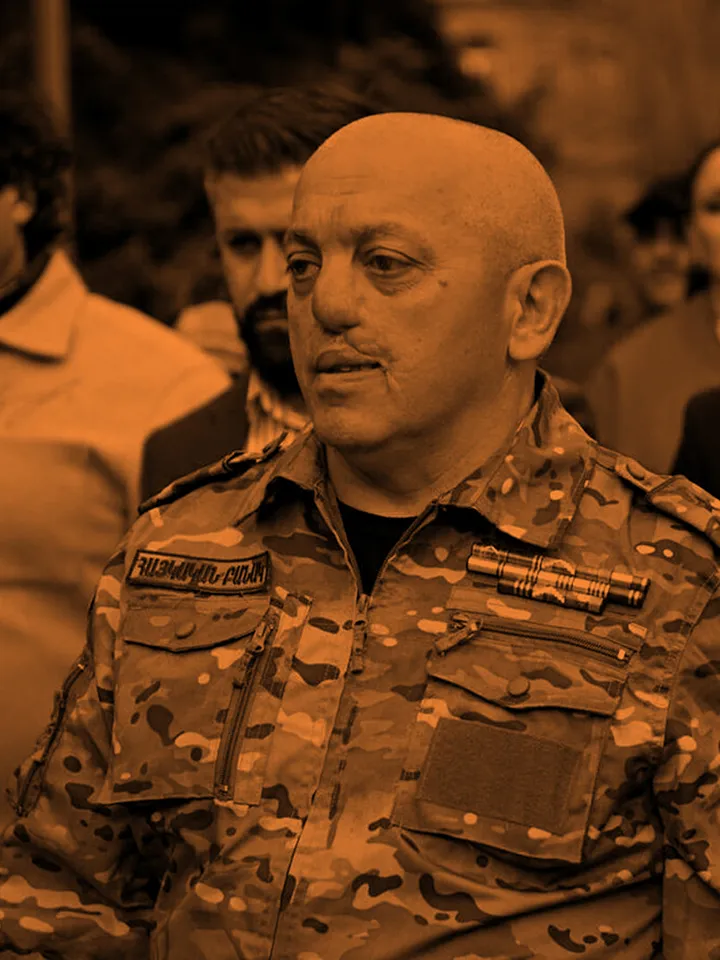
Artur Avanesyan
Charges
Giving electoral bribes (Article 219 of the RA Criminal Code), two episodes
Preventive measures
| Type | Period | Duration |
|---|---|---|
| Detention | 27 Apr 2026 – 25 Jun 2026 | |
| House arrest | 25 Jun 2026 – 23 Sep 2026 | |
| Administrative supervision | 23 Sep 2026 – ongoing |
Facts and Justification
On April 27, 2026, Artur Avanesyan, the head of the security team of the “Strong Armenia” alliance and an officer from Artsakh, was arrested and subsequently remanded in custody. He was charged with offering and promising electoral bribes, based on two episodes.
The Armenian Center for Political Rights assesses that the primary purpose of the persecution of A. Avanesyan is political, and he has been deprived of liberty in a discriminatory manner compared to others. The justifications for this assessment are presented below.
TThe First Wiretap
On April 27, the RA Anti-Corruption Committee (ACC) published a wiretap in which A. Avanesyan speaks in the Artsakh dialect with his supporters.
In one of the episodes, in response to the question of his interlocutor A. I., whether his words about giving a position in the army were in effect, Avanesyan replied that “everything I say will be”. In another episode, in response to the interlocutor G. Z.’s remark that he wanted to “be included in those ranks in order to be able to find a job somewhere in the future,” Avanesyan replied:
“We are thinking about future work. Vote for us, make effort, vote, and there will be work, there will be land, there will be a home”
These segments of the conversation were assessed as a promise of electoral bribery (see details of case file ՀԿԴ/0135/01/26 on Datalex.am). It is noteworthy that creating 20,000 affordable housing units, 300,000 new jobs, and implementing similar social programs in Armenia were among the promises included in the election program of the “Strong Armenia” alliance.
Other segments of the wiretap.
To assess the persecution of A. Avanesyan, it is necessary to consider other segments of the wiretap and address the logic of the wiretaps published by the ACC during the election period. After the elections, on June 10, the Chairperson of the ACC, Artur Nahanapetyan, insisted that the wiretaps published by his organization related exclusively to cases of electoral bribery. Responding to journalists’ questions at a briefing in the National Assembly as to whether the wiretaps were edited or taken out of context, A. Nahanapetyan replied:
“I assure you, there is no recording, there is no piece of any published recording that is taken out of context. That is, the segments of the recordings were published in full that were relevant to a particular political party, that is, contained data that it belongs to this or that political party, and the conversation related to specific electoral bribery”
Artur Nahanapetyan, Chairperson of the RA Anti-Corruption Committee (June 10, 2026)
However, other segments of A. Avanesyan’s wiretap clearly do not relate to the alleged electoral bribery. For example, at the very beginning of the recording, the following conversation is presented with his interlocutor O.S.:
O.S. - What’s new, how are you?
A. Avanesyan - Not much. Work and home.
O.S. - Are you going there?
A. Avanesyan - Yes.
O.S. - Are they giving money, though?
A. Avanesyan - Yes.
O.S. - Well, the main thing is that they give money.
A. Avanesyan - Yes.
The “Strong Armenia” alliance had announced in March that Artur Avanesyan was the head of their security team, so it is logical that he would be compensated for his work for the alliance. In other segments of the recording, Avanesyan’s interlocutors express their readiness to support the “Strong Armenia” alliance, but there is no hint of coercion or financial compensation in those segments (the wiretap, transcribed by the ACC, is available here). Therefore, the inclusion of these segments in the published wiretap does not align with the Chairperson of the ACC’s claim that they were not taken out of context and related only to cases of electoral bribery. Consequently, the logic behind their publication does not stem from the function of informing the public about alleged electoral violations but rather pursues a different purpose.
The use of wiretaps by the ACC for propaganda purposes against the ruling party’s rivals becomes even more evident from the content of the second wiretap related to Avanesyan.
The Second Wiretap
On May 20, the ACC published another wiretap, which indirectly relates to A. Avanesyan. The recording consists of four cut and joined segments, where two people discuss A. Avanesyan, using his military nickname (“Kandaz”).
ACC Transcription: Artsakh dialect
A. - Bro, they say, 2-3 colonels, they say he’s foul.
E. - Who are they talking about?
A. - Kandaz.
E. - Now let’s say, these same guys, bro, these same guys are with Kandaz, because they know that soon Kandaz will get a position and will take them with him, if he doesn’t take them, then everyone…
A. - That will happen anyway, Gohar, that…
E. - Who?
A. - Gohar, our Gohar, that girl, let’s say, at minimum, she will become Minister of Diaspora.
[End of first segment]
A. - Where was he during the Four-Day War?
A. - The man’s name is put as a hero of the war, I want to understand for what merit.
S. - But it’s you [plural] who put it, you blame yourself. Didn’t you [plural] put [him] as a hero of the war, my friend, wasn’t it from you?
[End of second segment]
S. - I’ll say we made [him] a hero of the war, Arega did. The heroes of the war, bro, come, I’ll show you, let’s go to Yerablur, and I’ll show them to you.
[End of third segment]
A. - Yesterday, when they arrested him, the police chief of Martakert was with me in the warehouse. He says he supposes that they are arresting him in Norik Danielyan’s case.
A. - In 1991, Norik Danielyan was the first volunteer commander of the Martakert defense zone.
A. - Norik Danielyan. His deputy argued with him, so he ordered Kandaz to shoot him [the deputy] in the head.
A. - Let’s say, what does the man have to do with it, as many men as he killed.
[End of fourth segment]
The inclusion of these segments again contradicts Artur Nahanapetyan’s claim that the ACC publishes only wiretaps related to electoral crimes of a corrupt nature. The fact that it consists of four separate pieces testifies that some employee of the ACC performed the specific selection and editing of the wiretap segments. The content of the wiretap is gossip from unknown persons, the purpose of which is to discredit A. Avanesyan, and the materials of the criminal case against A. Avanesyan available in Datalex.am contain no charges other than offering electoral bribes.
The Real Purpose of the Persecution
The Anti-Corruption Committee’s jurisdiction is limited to pre-trial criminal proceedings for alleged corruption offenses (see Article 4 of the RA Law “On the Anti-Corruption Committee”). However, the wiretap published on May 20th contained no mention of any corruption-related criminal offense attributed to A. Avanesyan. Instead, the ACC published a private conversation between individuals questioning A. Avanesyan’s integrity as a serviceman, where he is accused of murder. Incidentally, the individual mentioned in the wiretap, N. Danielyan, was not the commander of the Martakert defense zone in 1991; in 1990, he was arrested by Soviet forces and imprisoned in Shushi and Baku until the end of 1992.
ACPR concludes that the deliberate publication of rumors by unknown persons regarding A. Avanesyan’s military path and past during the election campaign is aimed at discrediting the serviceman, thereby attempting to reduce support for the opposition “Strong Armenia” alliance.
Discriminatory prosecution
Regardless of the factual basis of A. Avanesyan’s accusation, his criminal prosecution is carried out in a discriminatory manner compared to others. In the context of the 2026 National Assembly elections, more than a hundred people, exclusively representatives and supporters of opposition parties, were prosecuted and arrested on suspicion of corruption-related electoral crimes, while in the presence of credible evidence of similar crimes, no criminal prosecution was initiated against supporters of the authorities.
One such evidence was the alert from the “Akanates” observation mission on April 27, which was later included in the mission’s preliminary report. According to the alert,
“In April 2026, the management of the Bagratashen Customs Office held informal meetings with local administrative officials from border communities in the Tavush and Lori regions, as well as with business representatives. These meetings took place both on customs premises and at private venues and were accompanied by hospitality. According to the information received, participants were promised preferential treatment if they ensured the re-election of the ruling Civil Contract party and the Prime Minister.”
Despite the clarity of the alert, the ACC not only failed to conduct or publish “wiretaps” as in the cases of alleged electoral bribery in favor of the opposition but also did not initiate criminal proceedings at all. The details regarding the discretionary and discriminatory practices of law enforcement agencies in connection with corruption-related electoral crimes during the pre-election and post-election periods are available in the ACPR statement of 09.07.26 “On the issue of pre- and post-electoral political persecution in Armenia and the election results”.
In such circumstances, the application of detention and house arrest within the framework of criminal prosecution against A. Avanesyan corresponds to the situation described in criterion d of the definition of a Political Prisoner by the Parliamentary Assembly of the Council of Europe (Resolution 1900 (2012)):
A person deprived of his or her personal liberty is to be regarded as a ‘political prisoner’:
…
d. if, for political motives, he or she is detained in a discriminatory manner as compared to other persons.
Political motivations for prosecution
- To reduce public support for the “Strong Armenia” alliance, a participant in the 2026 NA elections.