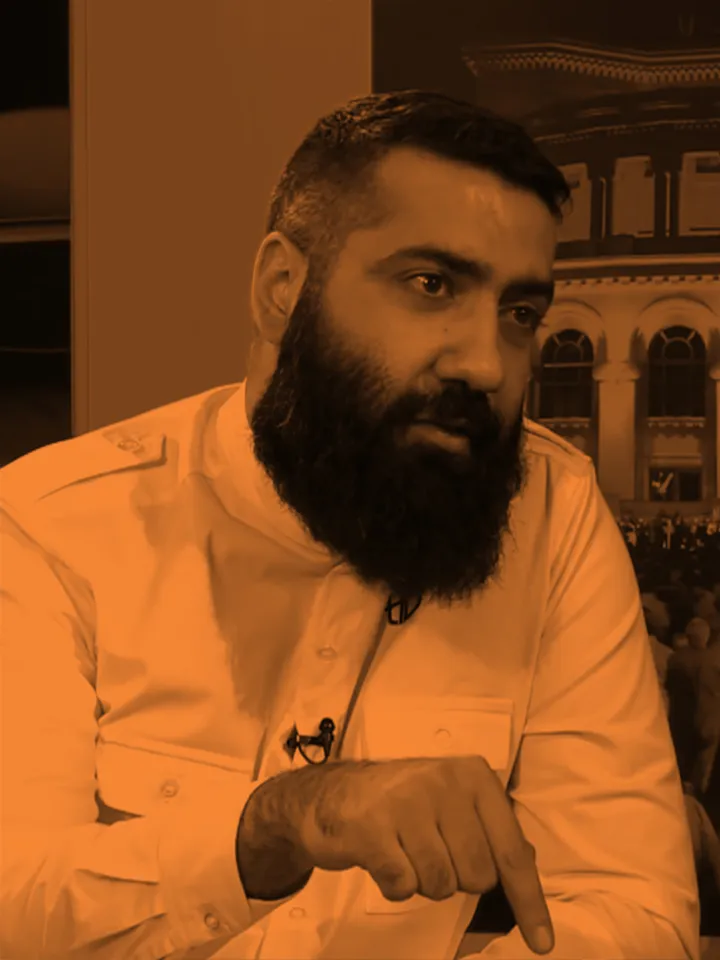
Artur Danielyan
Charges
Hooliganism using the information and communication technologies (Article 297, part 2 of the Criminal Code of the RA), dissemination of defamatory information about an investigator, head of an investigative body, in connection with the legitimate official or professional activities of the said persons (Article 490, Part 2 of the Criminal Code of the RA)
Preventive measures
| Type | Period | Duration |
|---|---|---|
| Detention | 07 Oct 2026 – ongoing |
Facts and Justification
On October 7, 2026, opposition public and political figure Artur Danielyan was detained and subsequently arrested. He was charged with hooliganism and disseminating defamatory information about a law enforcement (National Security Service).
The Armenian Center for Political Rights assesses that A. Danielyan’s charges, and consequently his imprisonment, are not prescribed by law, and the motive for the persecution is political. Below are the justifications for the assessment.
First Charge
The first charge relates to posts made on A. Danielyan’s Facebook page, which were qualified as “hooliganism” by law enforcement. Since A. Danielyan’s arrest, there has been no official statement specifying which particular posts were deemed such. His Facebook page contains numerous political commentaries and criticisms of the authorities’ actions, sometimes with detailed analyses and sometimes with harsh and coarse language.
The Armenian Center for Political Rights has previously addressed the offense of “hooliganism” as a tool used against harsh criticism of the authorities. Insult has been decriminalized in Armenia twice; in the old criminal code, insult was decriminalized in 2010, and the offense of “grave insult,” added to the new code in 2021, was decriminalized in 2022. However, in many cases, the use of profanity against the authorities or any official has been deemed hooliganism in itself, which is an arbitrary and unlawful interpretation of the law. Details are available in the ACPR’s report of 12.04.2024, A “Crime” Without Law: Political Persecution against N. Samsonyan and V. Saghatelyan (pp. 4-8).
Qualifying written expressions made in the digital realm as “hooliganism” turns an already broad, vague, and archaic offense into a tool of censorship. The origins of this offense, found in the criminal laws of several post-Soviet countries lie in late Tsarist Russia and early USSR. At the time, hooliganism was directly related to certain unacceptable behavior in public places, it had an element of “class” affiliation and had to be directed against public order (Wurst, Noelle, Power, Punk, and Performance: A Critical Analysis of Hooligan Laws in Russia (2019). Honors Program Theses. 94., pp. 18–27). The “hooligan” publicly mocked the Soviet ideas of the abolition of classes, with drunkenness, violence, debauchery, and “immorality.” (Wurst, p. 25). Furthermore, hooliganism must manifest as blatant disrespect towards members of society; even if a gross violation of public order has occurred, if it has not manifested as blatant disrespect towards society, it cannot be qualified as hooliganism (see the decision of the RA Court of Cassation in criminal case ԱՎԴ/0014/01/11, point 17).
Applying this concept mechanically to the online sphere, effectively creating an “online hooliganism” offense, fails to account for the manifestations of the latter or the specifics of the online environment. According to the Armenian Center for Political Rights, harsh criticism of officials online, even involving the use of offensive language, cannot be classified as hooliganism:
Firstly, social networks are created by private organizations with their own predefined rules of conduct; information spreads within them regardless of state borders, and the user decides for themselves which information sources to read or whom to follow. In this domain, the key concepts for the offense of “hooliganism,” such as public order and blatant disrespect towards members of society, cannot be interpreted in the same way as in real world, and the application of analogy to offenses in the criminal code is prohibited (see Article 4 of the RA Criminal Code).
Secondly, in Armenia, only judges and the Human Rights Defender are protected by criminal law from insult, and exclusively when the insult is related to the exercise of their official powers (see Article 489, Part 2, and Article 494 of the RA Criminal Code). In the context of the decriminalization of insult (twice), the only legal remedy against harsh vocabulary or profanity is a civil claim for insult or libel (RA Civil Code, Article 1087.1). Moreover, for statements concerning the government and public officials, the threshold for permissible criticism is higher than for other citizens (see, among others, Lombardo and others v Malta, No. 7333/06, para. 54, ECtHR, 24.04.2007).
As mentioned, the law enforcement agencies have not publicly disclosed which of A. Danielyan’s posts formed the basis for the criminal prosecution against him. An examination of his first and second personal pages on the social network Facebook shows that A. Danielyan consistently publishes political commentary and analyses, within which he sometimes criticizes the authorities and public officials with harsh language. We have not found any post that could correspond to the conditions of the offense of “hooliganism” described above.
In the absence of any evidence to the contrary, the Armenian Center for Political Rights finds that the criminal prosecution against A. Danielyan regarding “hooliganism” is not provided by law and is therefore illegitimate.
Second Charge
The second charge brought against A. Danielyan is based on Article 490 of the RA Criminal Code. This article provides protection for a number of public servants, participants in legal proceedings, and their close relatives against the publication of defamatory or harmful information, threats thereof, or threats of violence or property damage against them.
As with the first charge, law enforcement agencies initially did not release any official statement or information about the specific Facebook post that served as the basis for the criminal prosecution. According to A. Danielyan’s lawyer, the charge was brought for “defaming” the RA National Security Service (NSS) through a Facebook post.
Defaming the NSS as a public body is not an offense under the RA Criminal Code. Article 490 of the Criminal Code, under which A. Danielyan is charged, relates to the publication of defamatory information (Part 2 of the article) about a specific official (for example, an NSS investigator) or threats thereof (Part 1 of the article). This is clear from the wording of the basic offense: Part 1 of the article refers to threatening to publish defamatory information about such officials in connection with their official activities. That is, the crime would be committed if, for example, the accused in a criminal proceeding tried to “blackmail” the investigator to perform a certain action in their favor.
The applicable part of the offense attributed to A. Danielyan is as follows:
“publication of defamatory information about an investigator, head of the investigative body […] related to the lawful official or professional activities of the said persons.”
An examination of A. Danielyan’s personal pages on the social network Facebook (first and second) did not reveal any post where defamatory or disparaging information was published about any NSS investigator. Instead, there are posts where A. Danielyan criticizes the work of the NSS as a law enforcement agency. One such post, dated October 2, 2026, refers to the incident where an Azerbaijani soldier who had entered the house of a resident in Shaki village and wounded the mother in the presence of children by shooting at her.
They waited until the remaining two members of the infiltrated group safely left the territory of Armenia (by exiting towards Kovesakan) and the NSS announced that there was no such thing, it was all a lie: Before they left, they didn’t dare to either deny or arrest them: All that’s left is to hide the issue of one corpse under the rug…
Arthur Danielyan’s Facebook post of 02.10.2026
These and similar posts cannot be considered a crime in the sense of Article 490 of the Criminal Code. It refers not to a specific NSS investigator but to the entire law enforcement structure. Moreover, the criticism is clearly conditioned not by the lawful official or professional activities of the investigators but by the evaluation of a matter of public interest. In such cases, freedom of expression is not only not criminalized but the sphere for limiting it is much narrower (see Wingrove v. UK, No. 17419/90, para. 58, ECtHR, 25.11.1996).
As mentioned, the law enforcement agencies did not release any official statement or information about the specific Facebook post that served as the basis for the criminal prosecution under Article 490, Part 2, of the RA Criminal Code. Our examination did not reveal any post that would correspond to the attributed offense. In the absence of any evidence to the contrary, the Armenian Center for Political Rights finds that the criminal prosecution against A. Danielyan under Article 490, Part 2, of the RA Criminal Code is not provided by law and is therefore illegitimate.
Political Nature of the Persecution
As mentioned, the limitation of A. Danielyan’s rights in the context of the charges is not based on law and therefore cannot pursue a legitimate purpose. The posts that served as the basis for the charges (in the absence of any claim to the contrary) refer to criticism directed at the authorities, including the NSS, which, however harsh, cannot be a basis for criminal prosecution. Furthermore, the harshest measure of restraint possible—detention with a ban on visits (except with the lawyer)—was applied to A. Danielyan. These circumstances alone are sufficient to reveal the political motivation of the persecution: to limit political criticism and punish political speech.
The application of detention in the framework of the criminal prosecution against A. Danielyan corresponds to the situation described in criterion (a) of the definition of a political prisoner by the Parliamentary Assembly of the Council of Europe (Resolution 1900 (2012)):
“A person deprived of his or her personal liberty is to be regarded as a ‘political prisoner’…
a) if the detention has been imposed in violation of one of the fundamental guarantees set out in the European Convention on Human Rights and its Protocols (ECHR), in particular freedom of thought, conscience and religion, freedom of expression and information, freedom of assembly and association.”
Political motives of persecution
● To limit, reduce or hinder his/her or other persons’ political speech, as well as to force them to change (censor) their political speech and behavior, including criticism.
● To punish for political speech, behavior or beliefs.