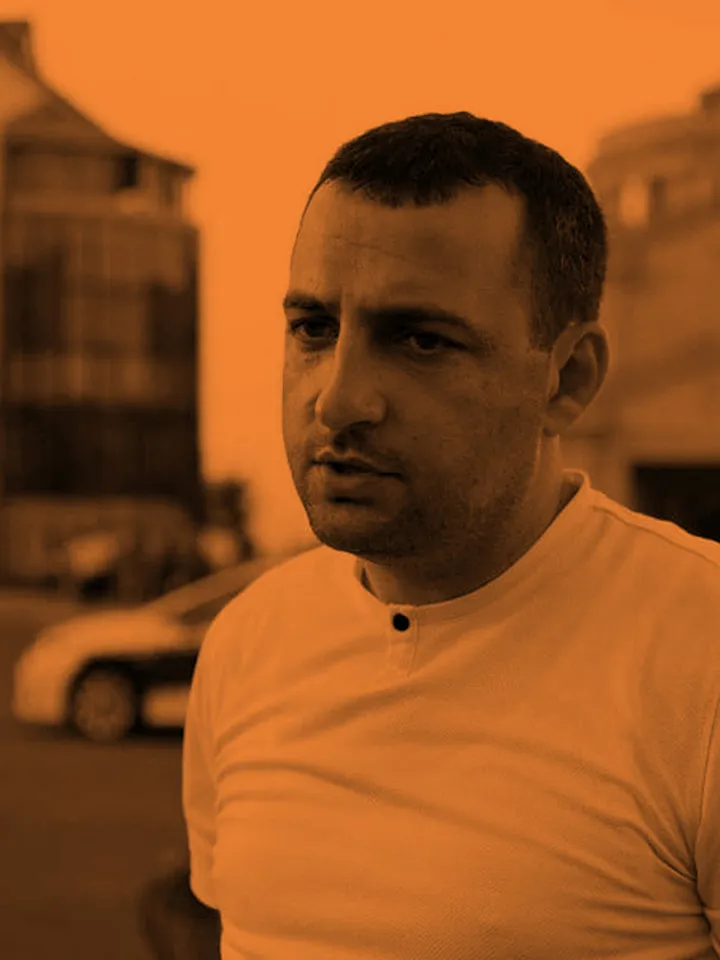
Artur Osipyan
Charges
Obstructing Election Campaigning (Article 211), Hooliganism using the information and communication technologies (Article 297, part 2 of the Criminal Code of the RA), Public calls for violence (Article 330, part 2 of the Criminal Code of the RA)
Preventive measures
| Type | Period | Duration |
|---|---|---|
| Detention | 18 May 2026 – 10 Jun 2026 |
Facts and Justification
On 18 May, Artsakh-born politician Arthur Osipyan approached Nikol Pashinyan during a campaign event and, with Pashinyan’s consent, asked him a series of questions and criticised him. The questions concerned the negotiations on the Artsakh question, which had stopped during Pashinyan’s tenure as Prime Minister, as well as political developments preceding the forced displacement of the entire population of Artsakh in 2023. At a certain point during the exchange, Pashinyan’s bodyguards and supporters forcibly removed Osipyan, while Pashinyan himself directed insulting remarks at him.
A. Osipyan was subsequently charged under three different articles of the Criminal Code.
1․ Obstructing Election Campaigning (Article 211)
The Investigative Committee of Armenia characterised his questioning of Pashinyan as obstructing the normal conduct of election campaigning. The entire incident was captured on video footage, which clearly shows Pashinyan agreeing to answer Osipyan’s questions. The exchange ended only at Pashinyan’s own initiative, when his bodyguards and supporters forcibly removed Osipyan. In such circumstances, the accusation of obstructing the normal conduct of election campaigning lacks any factual or legal basis.
2․ The Hooliganism Charge (Article 297)
The crime of “hooliganism"requires the manifestation of blatant disrespect toward society. In the absence of such an element, conduct cannot be classified as such.
Osipyan arrived at the campaign venue with the aim of asking the incumbent Prime Minister - who was simultaneously a candidate for office - questions on matters of public interest. This was voluntarily accepted by Pashinyan himself. Moreover, asking questions about the Artsakh issue, and particularly about the right to self-determination, to the candidate of a political party that now considers the issue closed and prohibits discussion of it, is entirely logical when that same political party, in its 2021 election programme, described “ensuring the security of the people of Artsakh through the realization of the right of self-determination of the Armenians of Artsakh” as one of its principal foreign policy priorities. In these circumstances, questions seeking clarification of the Prime Minister’s (or candidate’s) position were entirely legitimate and well-founded. Furthermore, throughout the discussion Osipyan addressed Pashinyan respectfully, whereas the same cannot be said of Pashinyan’s conduct toward Osipyan. Accordingly, there is no basis whatsoever for alleging “hooligan motives.” Indeed, the exchange between Osipyan and Pashinyan ended only when Pashinyan’s bodyguards and supporters physically dragged Osipyan away, while Pashinyan insulted him. If any unlawful conduct occurred during the incident, it was exclusively in the actions of Pashinyan or his supporters.
3․ Public Calls for Violence (Article 330)
According to the Investigative Committee, the basis of the charge was a Facebook post published by Osipyan on 22 March. The posts do not contain the protected characteristic element required for the application of Article 330 - namely, that the speech be motivated by the target’s political views. Consequently, they do not constitute hate speech. It is evident from the wording of the posts that the reason for the harsh language and criticism was Osipyan’s perception of Pashinyan’s political conduct and statements.
On the practice of unlawful application of the Article 330 of the Criminal Code of the RA, and details on Artur Osipyan’s persecution and justification of the claims are available in the “Hate Speech” laws as a tool of political persecution ad hoc report dated 03.06.2026.
Political motives of persecution
● To limit, reduce or hinder his/her or other persons’ political speech, as well as to force them to change (censor) their political speech and behavior, including criticism.
● To punish for political speech, behavior or beliefs.