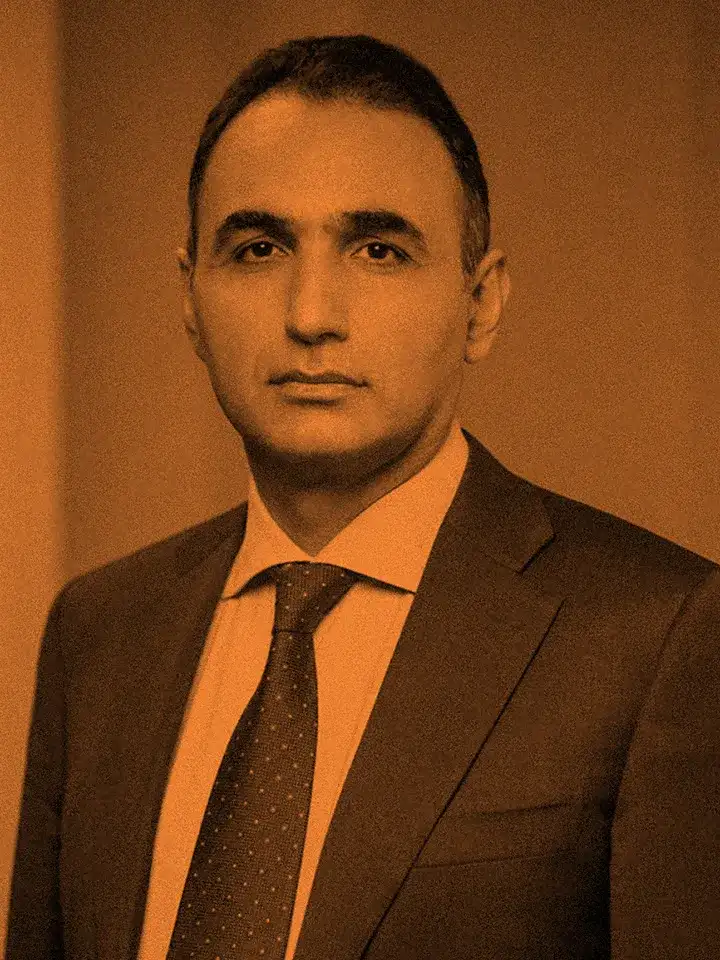
Avetik Chalabyan
Charges
Preparation of obstructing the exercise of the right to vote (Article 43-210, Part 2 of the Criminal Code of the RA)
Preventive measures
| Type | Period | Duration |
|---|---|---|
| Detention | 24 Jun 2026 – 21 Aug 2026 |
Facts and Justification
On June 24, 2026, Avetik Chalabyan, the coordinator of the “HayaQve” alliance, was arrested and subsequently remanded in custody. He was charged with “preparation for obstructing the exercise of the right to vote by a group of persons using official or service powers or influence conditioned by them, by prior agreement.”
According to the Armenian Center for the Protection of Political Rights, the main motive for the prosecution against A. Chalabyan is political. The grounds for this assessment are presented below.
Charges
On the day of A. Chalabyan’s arrest, June 24, 2026, the Investigative Committee of the Republic of Armenia (IC) released the following statement.
[…] A.Ch., acting as the coordinator of the “Hayakve” association, with the aim of obstructing the free exercise of the electoral rights of persons eligible to vote in the parliamentary elections held in the Republic of Armenia on June 7, 2026, in May 2026 traveled and held meetings with officials of another state. During these meetings, by persuading them and inducing their interest in ensuring the victory of a political force preferred by them in the aforementioned elections, he incited them to act as part of a group, with prior agreement, to use their official powers, governmental authority, and the influence arising from those powers to obstruct the free exercise of the electoral rights of Armenian citizens eligible to vote in the parliamentary elections held in the Republic of Armenia on June 7, 2026. Specifically, through the owners of business entities operating in that state, they were to compel Armenian citizens employed by those organizations and possessing voting rights to travel to the Republic of Armenia and vote in favor of the “Strong Armenia” alliance during the parliamentary elections held on June 7, 2026. An agreement to this effect was reached. […]:
The criminal proceedings and the charges brought against A. Chalabyan were triggered by a recording published in the pro-government Telegram channel @bagramyan26. The downloaded version of the recording, as well as its transcript, are available here. A. Chalabyan’s defense team stated that “the source of the recording and its authenticity are not established.”
The Secret Recording
The recording, lasting four minutes and 33 seconds, consists of at least four segments.
In the first segment, an unknown person (according to the Investigative Committee, the first secretary of the Embassy of the Russian Federation, Aleksandr Malyshev) asks what else he can do to support the “cleanliness and transparency of the elections” besides involving CIS and Russian observers. The interlocutor (according to the IC, A. Chalabyan) replies, “the arrival of a large number of voters, for example.” Significantly, a third person (according to the IC, Kristina Alyonkina, the third secretary of the Embassy of the Russian Federation) expresses surprise, believing that they can vote in their country of residence. In response, the interlocutor states that the law allows only those carrying out diplomatic missions to vote abroad.
Then, the interlocutors discuss the difficulties for citizens to travel to Armenia to vote (requiring certain efforts, motivation, and money). Here, the interlocutor (according to the IC, A. Chalabyan) suggests contacting a transport company that carries out infrastructure work under public procurement contracts to arrange for its Armenian citizen employees to travel to Armenia and “vote the right way.” At the same time, the interlocutor suggests talking to Armenian communities, which can also partially organize this as they share a common interest. The first segment of the conversation ends here. The remaining segments discuss options for maintaining contact and touch upon sociological issues. In the very last segment, the interlocutor (according to the IC, A. Chalabyan) says, “we’ll wait for answers to our questions. Please try to help us a little.”
Contradictions in the Presented Charges and Facts
According to the IC’s statement, A. Chalabyan “in May 2026 traveled and held meetings with officials of another state. During these meetings, by persuading them and inducing their interest in ensuring the victory of a political force preferred by them in the aforementioned elections, he incited them to act as part of a group, with prior agreement, to use their official powers, governmental authority, and the influence arising from those powers to obstruct the free exercise of the electoral rights of Armenian citizens eligible to vote in the parliamentary elections held in the Republic of Armenia on June 7, 2026. Specifically, through the owners of business entities operating in that state, they were to compel Armenian citizens employed by those organizations and possessing voting rights to travel to the Republic of Armenia and vote in favor of the “Strong Armenia” alliance during the parliamentary elections held on June 7, 2026. An agreement to this effect was reached”
There are significant contradictions between the IC’s statement and the content of the recording.
• Firstly, the recording was made in Armenia (the interlocutors mention “here” when referring to Armenia), although the IC’s statement creates the impression that the conversation took place abroad.
• Secondly, during the discussion about the transport of voters, there is no hint of coercion, although the IC uses the word “compel.”
• Thirdly, the recording does not mention any specific political force or any indication of voting for or against it. The only expression that could be interpreted as a guideline is “vote the right way.” Attributing it to any political party is arbitrary (more details below).
• Fourthly, and importantly, there was no approval or confirmation from the Russian officials for the option of transporting voters, even though the IC considers it established that an “agreement was reached.”
After the preliminary investigation was completed, i.e., when its confidentiality regime was lifted, A. Chalabyan’s defense team issued a statement. According to the statement, the timeline of the recording in the presented charge is different: A. Chalabyan’s meeting with the Russian officials took place not in May 2026 (as stated in the IC’s statement), but in February. According to the new charge, the recording was made on February 4, 2026, at “Minur” cafe, located at 13/2 Zakyan Street, Yerevan. In all other respects, the wording of the charge is almost identical, including the instruction to compel citizens to vote in favor of the “Strong Armenia” alliance, which is not mentioned in the recording.
This fact is particularly important because in February 2026, A. Chalabyan and the “HayaQve” initiative he led signed a memorandum of cooperation with the “Wings of Unity” party, led by the former Human Rights Defender of Armenia, Arman Tatoyan. This cooperation was terminated on April 10, 2026, and on April 29, “HayaQve” signed a new memorandum with the “Strong Armenia” alliance. The following contradiction arises: if the recording was made in February 2026 (as stated in the charge) and no desired political party is heard in it, why did the Investigative Committee “conclude” that the beneficiary must be the “Strong Armenia” alliance, with which A. Chalabyan was not cooperating?
Defense team also stated that A. Chalabyan “was arrested and detained on June 24, 2026 (by a different judge), 17 days after the publication of that recording. During all this time, he did not obstruct the course of the investigation in any way, did not attempt to flee, and did not commit any other illegal act that would justify the selection of detention as a preventive measure against him.” Furthermore, the defenders note that after his detention, for about a month and a half, “no witness was questioned, but only actions were carried out that he could not even obstruct (for example, appointing an expert examination or sending inquiries to mobile operators).” None of these claims were refuted by the Investigative Committee, which indicates that the deprivation of A. Chalabyan’s liberty is not due to the grounds necessary for pre-trial detention, as defined by the Criminal Procedure Code of the Republic of Armenia and accepted by international standards. Moreover, the significant contradictions between the charge brought against A. Chalabyan and the content of the recording themselves testify that the real purpose of the prosecution is due to political motives.
Facts Indicating the Existence of a Political Motive
During the 2026 RA National Assembly elections, the narrative of 100,000 “imported” voters arriving from Russia was circulated as a risk of foreign influence.
Following the elections, Factor TV and Infocom conducted a comparison of the number of people arriving in Armenia during the pre-election period and the same period in previous years. According to Factor TV, the number of Armenian citizens arriving in Armenia from May 1 to June 4, 2026, was 13,390 fewer than in the same period last year. The number of Armenian citizens arriving by air was only 2,571 more in 2026 than in the previous year. According to Infocom’s publication, the number of people with Russian passports arriving in Armenia from Russia from May 1 to June 7, 2026, was 28,296 more than in the previous year. Even if all of them also had Armenian passports (were dual citizens), the actual number of arrivals in Armenia would still be significantly less than the alarming 100,000.
Government officials also exploited the narrative of a mass arrival of voters from Russia to Armenia for the elections. On June 2, the Minister of Economy of the Republic of Armenia and Deputy Chairman of the Board of the “Civil Contract” Party, Gevorg Papoyan, responded to a question about the alleged arrival of “100,000 voters from Russia” in the upcoming NA elections as follows:
“I’m very happy about that because, first, our polling shows that most of those people will vote for us; and second, we need those people because training camps are currently being conducted - one-month ones, yes, and it would be very good if, say, 30,000–40,000 of those 100,000 people stayed here - we would send them to training camps. They would participate in training camps for a month or two and then return to Kaluga. So what? What’s the problem?”
In the same vein, the Deputy Head of the Office of the Prime Minister of the Republic of Armenia, Taron Chakhoyan, stated that voters arriving in Armenia from Russia would be involved in military training camps (military service), suggesting that they had received bribes to vote for the “Strong Armenia” alliance.
The Predominant Purpose of the Prosecution
The charge brought against A. Chalabyan is consistent with the narrative of “100,000 voters” arriving en masse from Russia to Armenia during the 2026 pre-election period, a narrative that was never substantiated by statistical data. Considering this fact, as well as the significant discrepancy between the charge brought against A. Chalabyan and the content of the recording and timeline attributed to him, it is evident that the real purpose of the prosecution was to reinforce a political narrative favorable to the government and to discredit political opponents.
Political Motivations for the Prosecution
1․ Discredit political opponents.
2․ Punish for political speech, conduct, or beliefs.
Additional Information
Avetik Chalabyan was convicted on December 21, 2023, to 2.5 years of restriction of liberty, being deprived of the right to organize assemblies and participate in other public events, as well as to change his place of residence. He was accused of “materially incentivizing participation in assemblies” (Article 236, Part 2 of the Criminal Code of the Republic of Armenia). According to the Venice Commission, in its current wording, this article does not comply with the principle of legal certainty. As a result, organizers of assemblies can be prosecuted for providing material incentives such as transportation, food, accommodation, or other organizational expenses for participants, which should not be prohibited.
More information is available in the joint report by the Helsinki Committee of Armenia and the Armenian Center for Political Rights dated January 10, 2024.
For more details on military “training camps” as a type of military service used as punishment, see the ACPR’s statement of June 4, 2026, and the report of December 9, 2024, “Training Camps: Discrimination “Prescribed by Law”.”